
Jamawar Pashmina Shawls: A Luxury Gift Guide for US Buyers

There are gifts that get a polite thank-you and a spot in the back of a drawer, and there are gifts that are still being worn three decades later. A Jamawar pashmina shawl belongs in the second group.
It’s not an impulse buy. A genuine one takes time to make, the price reflects that, and the person receiving it will know you didn’t grab it on the way home. This guide is written for US shoppers: what a Jamawar is, who will love one, which occasions deserve it, and what to confirm before you order.
What makes a Jamawar different
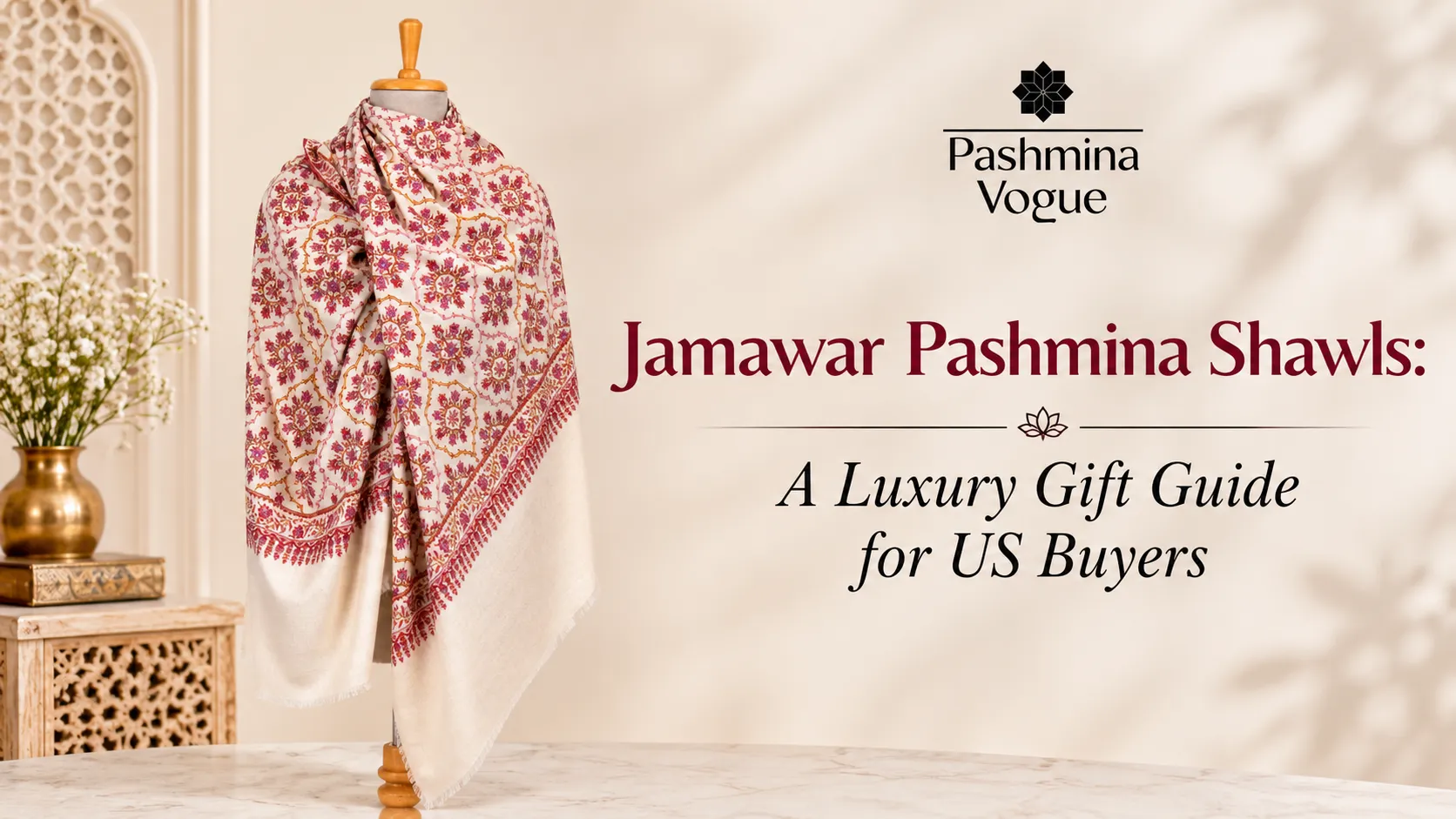
Plenty of pashmina shawls win you over with softness alone. A Jamawar asks for your attention with its design. Picture paisleys, curling vines, and clusters of flowers set so close together that the plain ground barely shows. Hold one up and it has the presence of a wall hanging more than a wrap.
Even the name hints at that heritage. “Jama” means robe and “war” means yard, so the word originally described cloth sold by the yard to make robes. Today the figures are woven into the textile, with some pieces enriched further by needlework, and all of it takes careful setup and many hours at the loom. That labor explains both the price and the heft: a Jamawar feels richer in the hand than a plain weave does.
Our post on printed vs patterned pashmina explains the wider difference between built-in and printed designs. For a gift, one idea is enough. In a Jamawar the pattern is part of the cloth itself, so it ages with the shawl instead of wearing off it.
Who it suits
This is a gift for someone who likes things made well and doesn’t mind a compliment or two. You probably already have a name in mind: the aunt who still wears her mother’s brooch, the boss retiring after thirty years, the friend who hunts through estate sales for old textiles, the mother of the bride who wants something grand for the reception.
It’s a harder sell for a person who dresses in plain beige and gets uneasy around pattern. If you’re stuck, picture her choosing between a soft, quiet cashmere wrap and something that gets people asking where she found it. If she’d reach for the second, you have your answer.
Occasions where it makes sense
Mother’s Day and big birthdays are the obvious ones. A 50th, 60th, or 70th calls for something with some weight to it, and a Jamawar has plenty.
The holidays work well too. Between December parties and chilly living rooms, an American winter gives a shawl a lot of chances to be worn, and a deep jewel tone looks festive without screaming “Christmas.”
Weddings are another good fit. For the mother of the bride or groom, a rich shawl can pull an outfit together, and as a present from the couple it’s a keepsake that doesn’t end up on a shelf.
Then there are the milestone moments: a 25th anniversary, a retirement, a thank-you to someone who has looked after your family for years. These are the times a gift should feel a little extravagant. It would be too much for an ordinary dinner party, but a host who has welcomed your family to Thanksgiving for decades may deserve exactly this.
Choosing the color
If you know nothing else about her taste, go with deep burgundy. It’s warm, a little formal, and kind to nearly every complexion. Emerald and forest green are close behind. They look wonderful in winter light and sit well next to gray, black, and cream.
A navy, charcoal, or black ground is the practical pick for someone who mostly wears dark clothes, and the pattern really stands out against it. Softer grounds like camel, sand, or champagne suit a lighter, warmer wardrobe, though you’ll want a pattern with enough depth that it still looks luxurious.
Ivory is gorgeous but unforgiving. It shows every mark, and at a wedding it can read as bridal. I’d only give it to someone who will baby it.
One trick: open her closet in your mind. If it’s all black and gray, a jewel tone gives her something she’s missing. If she already wears lots of color, a deep neutral will probably get more use.
Reading the pattern
No two Jamawars feel the same, and three details change the mood the most. A crowded, tightly packed pattern is dramatic and suits formal evenings, while a looser one is easier to wear on an ordinary Tuesday. A clear border frames the shawl and looks tidy when it’s draped, whereas a design with no border feels softer. And the size of the motifs matters: big ones read from across the room, small ones reward a closer look.
If you can’t see the shawl in person, ask for close-up photos taken in daylight. Screens flatter everything, and fine detail is precisely what you’re paying for.
How to tell the real thing from a lookalike
Because the price is high, a mistake costs more here than with a simple scarf. Machine-made copies of Jamawar designs are common, and in a catalog photo they can look very close to the real thing.
Start with the reverse side, and ask the seller for a photo if you can’t see it. In a properly woven piece the back shows the same design as the front, only a little rougher. A print tends to look pale or blank behind the pattern. Then think about touch: woven motifs have a subtle grain you can feel, while a printed surface is flat. Finally, put three questions to the seller. What is the fiber? How was the pattern made? Roughly how long did the shawl take? If the answers are vague or evasive, walk away.
Price is the last signal. A “handwoven pure pashmina Jamawar” that costs about as much as a mall scarf can’t be what it claims. When we list patterned pieces at Pashmina Vogue, we say how each one is made, so buyers aren’t left guessing. That’s a fair standard to hold any seller to.
US buyer checklist
Before you order, a few practical questions can save you a headache. Start with timing. Many Kashmiri shawls ship from overseas, so find out when yours will actually arrive, especially if it’s meant for a holiday or a date that can’t move. Order earlier than feels necessary.
Next, ask about import charges. You want to know whether the price you see includes them or whether a bill shows up at delivery, because a surprise fee on a gift is an unpleasant thing to explain.
Check the return terms as well: how long you have, and who pays to send it back. A present that doesn’t suit its recipient should be fixable.
Then ask for the details of the piece itself, meaning the technique, the fiber, and where it was made. A seller who knows the product answers quickly. Finally, if it’s going straight to the recipient, ask about gift packaging and whether the invoice will leave out the price.
How much to spend
Prices swing a lot depending on how dense the pattern is and how the shawl was made, so I won’t pretend there’s one right number. A heavily patterned, hand-worked piece is a serious gift. A simpler design can still be a lovely one at a gentler price. Settle on a budget you’re comfortable with first, then compare shawls inside it by looking at technique and detail, not just the figure on the tag.
Presenting it well
The way a gift arrives counts nearly as much as the gift. Fold the shawl in tissue, tuck in a handwritten note about why you picked it, and add a small card with care tips. If you know its story, such as where it was made or how long the pattern took to complete, tell her. People tend to cherish what they understand.
Looking after it
A short note of care instructions is a thoughtful extra. Suggest keeping the shawl in a cotton bag, out of bright sun and damp rooms. Because the pattern is so dense, it helps to change the fold lines every so often so the same crease doesn’t set in for months. If something spills, dab it and don’t scrub, then hand the shawl to a cleaner who regularly handles fine wool. It’s the same short routine we pass on to Pashmina Vogue customers.
Final thoughts
A Jamawar pashmina shawl takes more thought than a gift card, and that’s exactly the point. Pick a color that suits the person, make sure you know how it was made, and settle the practical details before you buy. If you’d like to see what’s available, you can explore the patterned collection at Pashmina Vogue.
Frequently Asked Questions
What is a Jamawar pashmina shawl?
It’s a pashmina shawl known for dense, all-over paisley and floral patterns built into the fabric by weaving or needlework, rather than printed on top.
Is a Jamawar shawl a good gift for a mother?
Yes. It suits milestone birthdays, Mother’s Day, and weddings, especially for someone who appreciates craft and likes a statement piece.
What color Jamawar shawl is the safest gift?
Deep burgundy, forest green, and navy are the most flexible choices, flattering across many wardrobes and skin tones.
How can I tell a Jamawar is not a printed copy?
Look at the reverse side and run a finger over the surface. A woven or stitched pattern has texture and looks consistent on the back, while a print feels flat.
What should US buyers check before ordering?
Confirm shipping time, import duties, return terms, and how the pattern and fiber are described, especially if the shawl is a holiday or event gift.
