
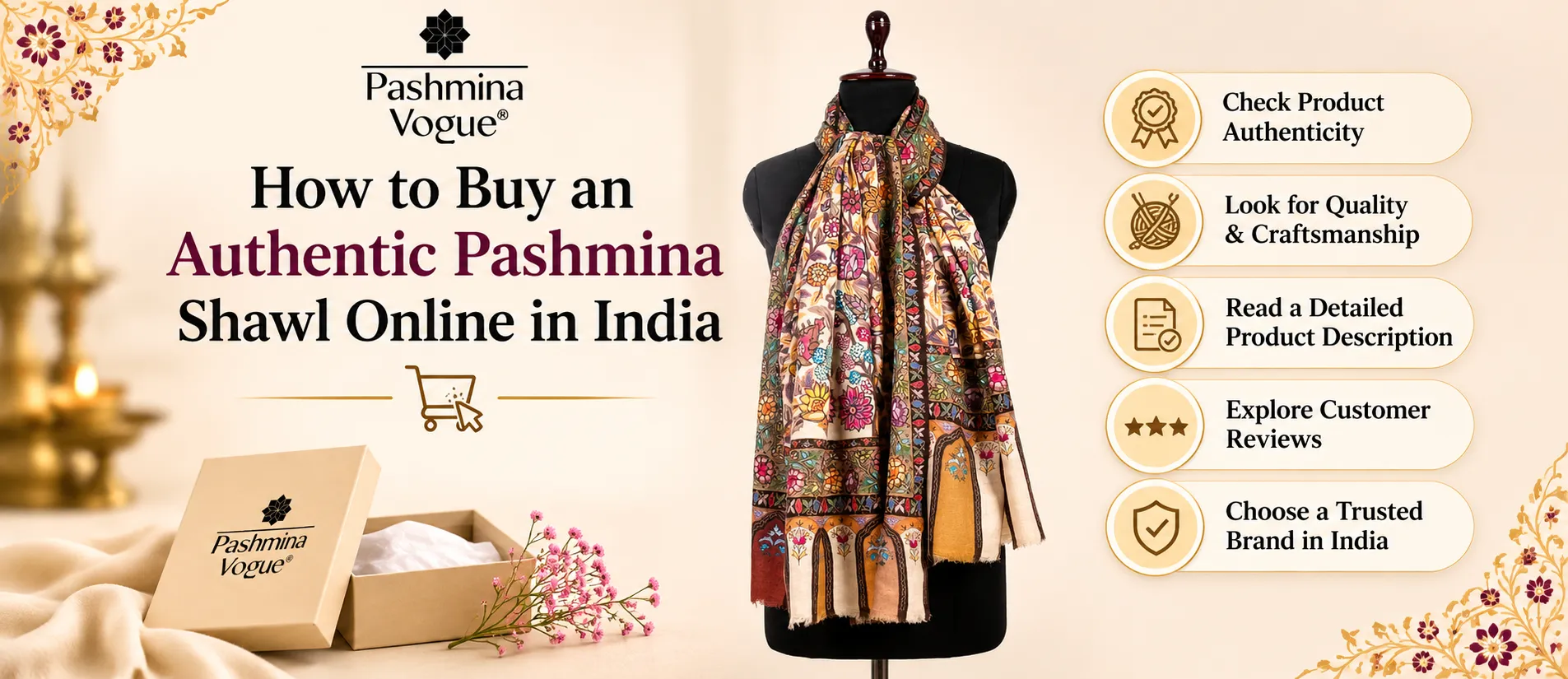
How to Buy an Authentic Pashmina Shawl Online in India

Searching for an authentic pashmina shawl online in India can feel like walking through a market where every stall swears its goods are genuine. Listings use the word freely. Prices vary enormously, and photographs rarely show what a shawl is actually made of. The good news is that buyers now have more ways to check than they did a few years ago, including a QR-based labelling system run out of Kashmir. This guide explains what real pashmina is, how to verify it before and after payment, and which warning signs justify closing the tab.
Know What You Are Shopping For
Pashmina is the fine undercoat of the Changthangi goat, raised on the high Changthang plateau of Ladakh. The fibre is generally cited at 12 to 16 microns in diameter, far finer than ordinary wool, which is why a real shawl feels light and soft yet holds warmth.
Three separate ideas get mixed up in listings, and it helps to keep them apart. The first is the fibre itself. The second is how the fabric was made: hand-spun and hand-woven in Kashmir, or produced by machine elsewhere. The third is decoration, such as printing, Sozni needlework or Kani weaving. A shawl can be made from pashmina fibre and still be machine-made, and an embroidered one can be beautifully worked on a blended base. Kashmir Pashmina holds a Geographical Indication (GI) tag, which ties the name to Kashmiri hand-spinning and hand-weaving. When a seller says “pure pashmina,” ask which of these they mean.
Verify the GI Label and QR Code
This is the strongest check available to an online buyer. According to Jammu and Kashmir’s Handicrafts and Handloom Department, products are tested at the Pashmina Testing and Quality Certification Centre (PTQCC) in Srinagar and then receive a GI label with a QR code. Officials say buyers can scan the code with a smartphone before purchase to confirm the product’s genuineness and other details, such as manufacturer, artisan and material. Rising Kashmir reports that over 70,000 products have been labelled.
Because you can’t hold the shawl, ask whichever seller you are dealing with, Pashmina Vogue included, for a clear photograph of the label and, ideally, a short video of them scanning it. The result should name the product as Kashmir Pashmina and match what you are buying. One caution of my own: a QR code is only an image, and an image can be copied. What counts is the information that appears when the code is scanned. If the page doesn’t match the listing, treat the label as unproven.
Also note that labelling is not universal yet. Many honest artisans and small sellers haven’t been through the process, and the system currently covers seven registered crafts. A missing label therefore doesn’t prove a fake, but it means you must rely on other evidence.
Read Also:- Is Your Pashmina Shawl Pure?
Read the Product Page Like an Inspector
A good listing answers questions before you ask them. Look for the exact fibre content, stated as a percentage, plus the weave, dimensions and weight. Photographs should show both sides, a close view of the weave, the edges and fringe, and the label.
Some wording should slow you down. “Pashmina-style,” “pashmina feel,” “wool blend,” “silk-pashmina” without percentages, and “pashmina” attached to a very low price all tell you the product may not be pure. Blends are not dishonest in themselves. Plenty of buyers like a silk-pashmina blend for its sheen. The problem arises when the listing implies pure fibre without saying so.
Be equally careful with printed designs, since a busy pattern can hide the quality of the cloth. Ask for a close-up of the print and a photograph of the plain border, where the weave is easier to judge.
Judge the Seller, Not Just the Shawl
Under India’s Consumer Protection (E-Commerce) Rules, 2020, platforms must display return, refund and exchange terms, and marketplace sellers’ details such as address and customer care number should be visible too. A May 2026 survey reported by Medianama found that most platforms still don’t show seller details as expected, so check yourself instead of assuming.
Before paying, confirm that the seller lists a physical address and working contact details, offers an invoice, and states a return window that applies to this product. Read reviews that carry customer photographs, because they show the shawl as delivered. Message the seller with a specific question, such as where the shawl was woven. A knowledgeable seller answers precisely and quickly. A seller such as Pashmina Vogue should be willing to explain fibre, origin and finishing in plain terms, and vague replies are a signal to look elsewhere.
What the Price Tells You
Pashmina is expensive because each goat yields little usable undercoat, and spinning and weaving by hand are slow. Kani and Sozni work adds many more hours of labour on top. So a plain machine-made scarf and a hand-woven, embroidered shawl cannot honestly cost the same.
Without quoting any rate, a few principles hold. A very low price for a large shawl described as pure, hand-woven and GI-certified is not plausible. A higher price does not prove authenticity either, because some sellers inflate prices to look premium. Ask what accounts for the cost: fibre, hand-weaving, embroidery, certification. A genuine seller can break that down. A fake can only repeat adjectives.
Checks When the Parcel Arrives
Record yourself opening the parcel, and check the shawl within the return window. First, compare the label and QR code with what the seller showed you. Then look at the cloth in daylight. Real pashmina is soft and light without feeling slippery, and the weave should look slightly irregular in the way handwork is, not mechanically perfect. Rub a small area of the plain weave gently between your fingers; it should warm up without pilling quickly, though heavily embroidered pieces may snag regardless of quality.
Check the print or dye. On a hidden corner, dab with a damp white cloth, and watch for colour transfer. Look at the edges and fringe as well, since sloppy finishing often suggests a rushed or machine-made piece.
Some popular tests are best avoided. The burn test is destructive, and blends can fool it. The ring test, pulling a shawl through a finger ring, proves very little, because many fine fabrics pass it. No home check replaces a verified label, so use the scan as your main evidence and your hands as a second opinion.
Mistakes That Cost Buyers Money
The most common error is trusting one signal, such as a certificate image or a glowing review, without checking anything else. Another is buying on price alone. Some buyers skip the return policy until a problem appears, by which time the window has closed. Others never compare the delivered shawl with the listing photographs. And many ignore size: a shawl that is too small to drape properly disappoints even when the fibre is perfect.
Read Also:- Where to Buy Pashmina Shawls in Kashmir?
Buy Slowly, Keep It for Years
A genuine pashmina is a purchase to keep for many winters, so a day spent checking is time well used. Ask for the label, scan the QR code, question the price and read the return policy. Whether you buy from Pashmina Vogue or someone else, the same questions apply, and a seller who answers them clearly has earned a closer look.
Frequently Asked Questions
Is every authentic pashmina shawl GI-certified?
No. A GI label is strong evidence, but not every genuine shawl carries one yet. Ask the seller how the product was made and tested, and weigh that against the other signs described above.
Can I verify a pashmina after buying it?
If the shawl has a GI label with a QR code, scan it. Otherwise, keep the invoice, photographs and the seller’s claims in writing, and use the return window if the shawl doesn’t match.
What’s the difference between pashmina and cashmere?
Pashmina is a very fine type of cashmere from the Changthangi goat. Kashmir Pashmina must also be hand-spun and hand-woven in Kashmir to qualify for the GI name.
Are marketplace listings safe?
They can be, if the seller is verifiable and the return policy covers the item. Treat each seller individually instead of trusting the platform’s name.
