

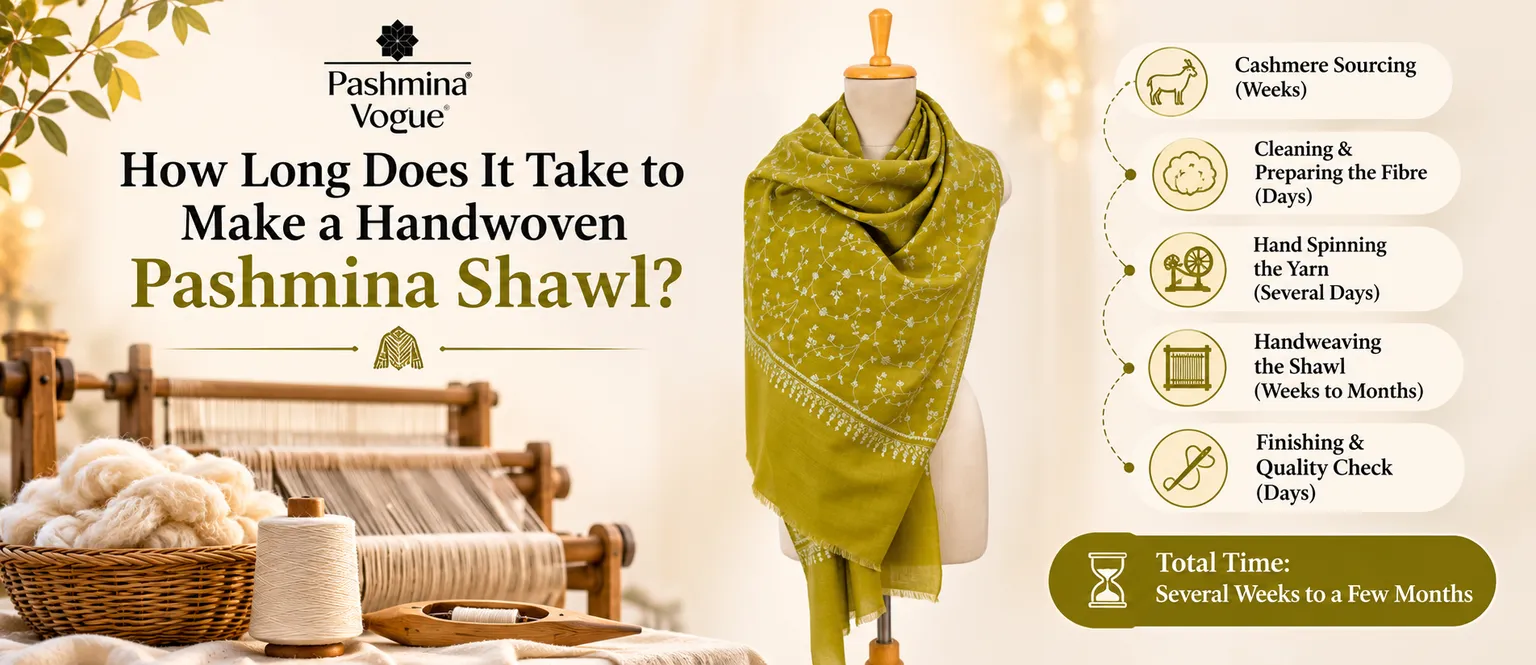
How Long Does It Take to Make a Handwoven Pashmina Shawl?

A plain handwoven pashmina can take a few weeks from raw fibre to finished piece, while an elaborately embroidered one can take months or even years. Neither figure is exact, because the time depends on the weave, the fineness of the yarn, how much embroidery is added and how many hands are involved. The more useful question is where the hours go, and the answer explains most of what you pay for.
Why there is no single answer
A handwoven pashmina is not made in one continuous process by one person. Combing, cleaning, spinning, dyeing, weaving, finishing and embroidery are often done by different artisans, sometimes in different villages or workshops, and each stage has its own queue. The timelines below are indicative ranges drawn from commonly described practice, and individual workshops vary.
Stage one: gathering the fibre
It starts on the Changthang plateau in Ladakh, where Changthangi goats grow a fine undercoat to survive winters in extreme cold. The fibre is collected in spring, when the animals begin to moult, and it is combed by hand rather than cut. This happens once a year, so the supply cycle is tied to the seasons.
A single goat gives only a small amount of usable fibre, and a shawl is commonly estimated to need the yield of a few animals, depending on size and weight. The raw fleece then travels to Kashmir, which means the calendar for a shawl often begins months before any weaving.
Stage two: cleaning and dehairing
The raw fleece contains coarse outer hair, dust and grease. Removing the coarse guard hairs is slow, skilled work, often done by hand, and it directly affects how soft the finished shawl feels. Poor dehairing leaves a scratchy, uneven fabric.
This stage can take days for the amount of fibre one shawl needs, though that depends on how clean the fleece is and how many people are working on it.
Stage three: spinning
Pashmina yarn has traditionally been spun by hand on a small wooden spinning wheel called a charkha. The fibre is so fine and short that it breaks easily, so the spinner must keep an even, gentle tension throughout. A thinner yarn makes a lighter shawl, but it takes longer to spin and is harder to weave.
For a standard shawl, spinning is among the most time-consuming steps, often described in terms of several days of work for the yarn alone. The warp threads, which run lengthwise, need to be especially strong and consistent, and the quality of this yarn is a large part of what separates a good shawl from an average one.
Stage four: dyeing
Yarn is usually dyed before weaving when a shawl will carry multiple colours, while plain shawls may be dyed after weaving. Dyeing itself is quick compared with other stages, but it needs care, since pashmina absorbs colour deeply and uneven results are hard to correct. Drying time also adds a day or two when the weather is cold and damp.
Stage five: preparing the loom and weaving
Before weaving begins, the warp must be measured, set up and tensioned on the handloom, and for a fine yarn this setup can take longer than people expect. Weaving then proceeds thread by thread on a wooden loom.
The weave decides the pace. A plain weave moves fastest, with a plain shawl often taking days to a week or more at the loom. A twill weave takes somewhat longer, and patterned weaves take longer still. Kani weaving is the extreme case. The design is built up with small wooden bobbins, one colour at a time, following a coded pattern, and one piece can take many months, with the most intricate designs reportedly taking a year or more.
Stage six: washing and finishing
A freshly woven shawl is not ready to wear. It is washed to soften the fabric, stray fibres and loose threads are removed, and the fringes are twisted by hand. This is careful work that can take a day or more per piece, and rushing it shows in the final drape and finish.
Read Also:- How to Wear a Pashmina Shawl?
Stage seven: embroidery
This is where timelines stretch the most. Sozni embroidery uses very fine needlework, and a shawl with a narrow border might take weeks. A shawl with dense work across the whole surface can take many months, and exceptional pieces are described as taking a year or longer.
The time scales with the area covered and the density of the stitches, so the same base shawl can be a few weeks’ work or a project of many months depending on the design. For readers interested in how embroidery affects value, our guide to choosing a pashmina as a Diwali gift explains what to look for in stitching quality.
A rough overview
Putting the stages together gives a general picture, though each number is a typical range and not a promise:
- Plain handwoven pashmina: a few weeks from fibre preparation to finished piece, assuming the yarn is ready.
- Pashmina with a border or light embroidery: about one to three months.
- Densely embroidered sozni shawl: several months to a year or more.
- Kani shawl: often many months and, for complex designs, a year or longer.
These figures assume steady work. In practice, weather, seasonal supply of fibre, the availability of skilled embroiderers and the number of orders in a workshop can all extend the schedule.
Why machine-made shawls take less time
A power loom can produce a shawl in a small fraction of the time, and the yarn is usually machine-spun from blended fibre, which is why those shawls cost far less. The difference is not just speed. Handspun, handwoven pashmina has a slight natural irregularity that gives it a softer feel and a more fluid drape, and it carries a craft tradition that machine production does not.
If you are buying for a festival, plan ahead. Made-to-order and embroidered pieces cannot be finished in a few days, and a reputable seller should be honest about lead times. Pashmina Vogue and other specialist sellers should be able to tell you whether a piece is ready to ship or made to order, and roughly how long the work takes.
How to judge whether the time claimed is realistic
Ask a few direct questions before buying a handwoven piece. Is it handspun or machine-spun? Was it woven on a handloom? Is the embroidery done by hand, and how many weeks or months did it take? A seller who can answer clearly is usually more reliable than one who speaks only in marketing language.
Be cautious if a seller offers a heavily embroidered “handmade” shawl at a low price with a very short delivery time. The labour behind real hand embroidery rarely fits that combination. Look at the reverse side too, since neat, secure stitching on the back is a good sign of careful work.
What the time tells you
The weeks and months behind a handwoven pashmina are the reason it costs more, feels different and lasts longer than a machine-made alternative. Knowing the stages makes it easier to see what you are paying for, and to spot a price that cannot be explained. When you next shop for one, ask the seller to walk you through the making, and Pashmina Vogue or any other genuine specialist should welcome the question.
Read More:- How Kashmiri Shawls Combine Warmth, Craftsmanship, and Everyday Elegance For Women
Frequently asked questions
How long does a plain handwoven pashmina shawl take to make?
Usually a few weeks in total, counting fibre preparation, spinning, weaving and finishing. The exact time depends on yarn fineness, shawl size and how many artisans work on it.
Why does embroidered pashmina take so much longer?
Because the embroidery is done stitch by stitch with fine thread, and the time rises with the area and density of the design. A narrow border is quick by comparison, while full-surface work takes months.
How long does a kani shawl take?
Many months at the least, and for complex multi-colour designs a year or more is commonly reported. The pattern is woven in using bobbins and not stitched on afterwards.
Does a longer making time mean better quality?
Not automatically. Time reflects the amount of handwork, but quality also depends on fibre grade, yarn evenness and finishing. Judge the shawl on those factors as well.
