There is a specific experience most American women in office environments know well.
You dressed appropriately for the weather outside. By 9:30 AM, the building’s air conditioning has made your outfit wrong for the temperature inside. The meeting room is six degrees colder than your desk. The open-plan floor runs the AC at whatever setting the facilities team set in 2019 and has not adjusted since.
A Pashmina shawl is the most elegant solution to this problem in existence – and almost nobody is using it as one.
At Pashmina Vogue, our handwoven Kashmiri shawls are worn by women across the US in exactly these contexts. This guide covers how to do it properly: which style works with which office dress code, which Pashmina types suit which professional settings, and the practical details that most styling guides never address.
Why Pashmina Works in the US Office Better Than Any Alternative
The problem is not unique to any one city or sector. US office buildings – particularly in financial services, law, consulting, tech, and healthcare – run air conditioning in a way that frequently disconnects from outdoor temperature. The result is an indoor environment that can be 10 to 15 degrees colder than the street outside during summer and aggressively climate-controlled in winter.
Standard solutions are all imperfect. A cardigan adds fabric weight and visual bulk. A blazer over a blazer is too much structure. A scarf is designed for outdoor cold, not indoor cold. A blanket at your desk is not professional.
A Pashmina shawl solves the specific temperature problem that US offices create – indoor cold in a professional environment – without adding the weight, bulk, or visual informality of the common alternatives.
The warmth-to-weight ratio of authentic pashm fiber is the reason. Hand-spinning on the charkha creates yarn with natural loft – trapped air between fibers that insulates more efficiently than additional fabric mass. A full-sized Pashmina shawl weighing under 300 grams provides genuine warmth without the visual weight that heavier alternatives carry. It also drapes rather than adding structure, which means it works alongside existing outfit structure rather than competing with it.
Pashmina Vogue’s plain weave collection is specifically suited to this use – lightweight, clean, professional in any neutral tone, and effective across the temperature range that US office environments actually present.
The Asymmetric Blazer Drape for Business Formal Settings
This is the styling method for the most formal US office contexts – law firms, investment banking, executive offices, and any environment where dress code is strict and visual polish is non-negotiable.
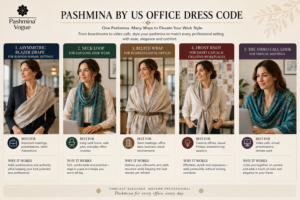
The setup: wear your standard business formal outfit (blazer, tailored trousers or pencil skirt, formal footwear). Take the Pashmina and drape it over one shoulder only, letting the longer end fall across the front of your body and the shorter end rest at the back.
The asymmetry is the point. It creates visual interest without adding the symmetrical bulk of a full shoulder drape, and it sits naturally on a blazer shoulder without disrupting the jacket’s structure. The Pashmina falls over the blazer rather than under it, adding a layer of warmth and softness against structured suiting.
For this look specifically, plain weave Pashmina in a solid neutral tone is the correct choice. Ivory, stone, charcoal, or deep navy work against any business formal palette. Embroidered pieces are appropriate for this setting but should have restrained decoration – a Sozni border rather than full-field embroidery. The shawl should be the softest visual element of the outfit, not the loudest.
Pashmina Vogue’s solid-color plain weave shawls in neutral tones are the most used pieces from our collection in formal professional contexts. They sit correctly on the shoulder of a structured blazer, provide all-day warmth, and add exactly the right proportion of visual softness to formal suiting.
The Neck Loop for Day-Long Desk Wear
For any office context involving extended time at a desk – which is most of them – the neck loop is the most practical and the most underused Pashmina styling method.
Fold the shawl lengthwise into a long strip. Drape it around the back of your neck. Pull both ends through the folded loop at the front. Adjust the loop so it sits loosely at the collarbone. This position allows a full day of work without the shawl slipping off your shoulders, requiring readjustment, or getting caught in your chair.
This is a critical practical detail that most styling guides miss. A shoulder drape looks excellent standing up. It slides off the moment you lean forward at a desk or reach across a keyboard. The neck loop eliminates that problem entirely while keeping the warmth exactly where it is most useful – across the chest and neck, which is where air conditioning is felt most acutely in a sitting position.
Color selection for the neck loop works differently from other Pashmina styles. Because the shawl sits close to your face rather than framing your body, color near the face matters more. A warm tone – camel, blush, terracotta – brightens the face and reads as intentional dressing. A neutral matching the outfit creates a tonal look that is subtle and polished.
For business professional contexts, this style with a plain weave Pashmina in a quality neutral is one of the most reliably appropriate office looks in the Pashmina Vogue collection.
The Belted Wrap for Business Casual Offices
US business casual offices – tech companies, marketing agencies, healthcare administration, mid-tier corporate environments – allow more styling variation while still requiring a professional appearance. The belted wrap is the Pashmina style that works best here.
Drape the Pashmina evenly across both shoulders, letting both ends fall at the front. Add a slim leather belt or a thin woven belt at your natural waist, over the Pashmina. The shawl becomes a structured outer layer – something between a wrap and a light coat.
The belt transforms the Pashmina from a draped accessory into a shaped garment. It creates a defined waistline, adds structure to what is otherwise a fluid fabric, and reads as a deliberate style choice rather than warmth management. Over a simple midi dress or fitted trousers and a blouse, the belted Pashmina is a complete outfit layer.
For this style, plain weave Pashmina works best – the belt needs to cinch cleanly without competition from embroidery or pattern work. Reversible Pashmina from the Pashmina Vogue collection works particularly well here because the belted format displays whichever face you select clearly, and the second face is available for a different look the same day.
The Front Knot for Smart Casual and Creative Workplaces
Creative studios, tech startups with casual dress codes, media companies, design agencies, and remote/hybrid work settings allow the most flexibility. The front knot is the Pashmina styling method that suits these environments while maintaining the intentional quality that separates a considered look from thrown-together.
Fold the Pashmina lengthwise into a narrow strip. Drape it around the back of your neck so both ends fall evenly at the front. Tie both ends in a single loose knot at chest height. Leave the knot relaxed – not cinched, not tight.
The front knot works because it creates a focal point (the knot) without adding bulk at the shoulders or requiring any structural support from the outfit. Over a fitted turtleneck and jeans or a straight-leg trouser and basic top, the knotted Pashmina provides warmth and visual interest from one movement.
For this style, color can be bolder. A deep emerald, saffron yellow, or cobalt over a neutral base outfit creates the color accent that makes the look intentional. Plain weave Pashminas in bolder tones from Pashmina Vogue – part of the solid colors collection – suit this format precisely.
The Video Call Look: What Reads Well on Camera
Remote and hybrid work have added a styling consideration that did not exist ten years ago: how the outfit reads on a laptop camera in a video call, typically from the chest up.
A Pashmina shawl in the right position is one of the best video call accessories available. The fabric provides color, texture, and visual interest at chest and shoulder level – exactly the frame that a standard video call captures. It also addresses the specific comfort problem of sitting in a home office or meeting room where the temperature is often colder than the rest of the space.
For video calls specifically, the full shoulder drape – even across both shoulders, both ends hanging at the front – reads best on camera. The fabric frames the face and adds visual weight at the shoulder line, both of which read as professional and composed on screen.
Color choice for video is more important than for in-person. On camera, pale neutrals (ivory, stone) can wash out if the background is also light. Deeper neutrals – navy, charcoal, camel – hold their presence better. A single jewel tone (deep burgundy, forest green) against a neutral outfit creates a strong camera presence without overwhelming the frame.
Choosing the Right Color for Your Office Context
This is the section that determines whether a Pashmina looks intentional or accidental in a professional setting.
Neutral tones – ivory, stone, camel, charcoal, navy – are the safest choice for formal and business professional environments. They work with any existing outfit palette, complement any skin tone, and read as polished rather than attention-seeking. For buyers who want one Pashmina that works every day in a formal office, one of these tones is the answer.
For business casual and smart casual settings, a broader color range is appropriate. Warm tones (camel, terracotta, blush) add visual warmth and work particularly well during fall. Cool tones (sage, dusty blue, slate) read as refined and suit spring and summer offices. Jewel tones (deep burgundy, emerald, sapphire) create a focal point that makes a basic outfit look considered.
One principle applies across all settings: the Pashmina and the outfit should share a tonal relationship. A camel Pashmina over cream and navy reads as a planned combination. The same camel Pashmina over a bold floral dress competes rather than completes. Pashmina works best as the connecting element between outfit pieces, not as an additional competing element.
The One Problem Nobody Mentions: Keeping Pashmina in Place at Your Desk
This is the practical detail that determines whether a Pashmina shawl works in an actual office or only in styling photos.
A shoulder drape that looks perfect standing up will slide off within ten minutes of desk work. Leaning forward to read a screen, reaching across a keyboard, or turning to speak to a colleague beside you will dislodge a simply draped Pashmina from a straight sit position.
There are specific solutions that maintain professional appearance without requiring constant adjustment.
The neck loop, described above, is the most reliable. It holds across a full day of desk work without any slipping risk.
For shoulder drapes, folding the shawl slightly at the point of contact with the shoulder – a small inward fold at the shoulder seam – creates friction against the blazer or top fabric that significantly reduces slipping.
A single small open-back pin placed at the back neckline, under the Pashmina where it is not visible, secures the shawl in place without leaving a mark on the fabric and without showing from the front.
A lightweight shawl brooch or clip at the front, where the two ends cross at the chest, anchors the drape visibly but also becomes part of the styling intention. Simple gold or silver closures look professional and read as deliberate.
Pashmina Vogue shawls are available in full-size dimensions that provide enough fabric weight to hold a drape position better than narrower stoles, which reduces slipping without additional accessories.
Frequently Asked Questions
Can you wear a Pashmina shawl to a formal office or business meeting?
Yes. A plain weave Pashmina in a solid neutral tone draped asymmetrically over one shoulder alongside a structured blazer is entirely appropriate for formal office settings including law firms, banking, and executive environments. The fabric’s softness contrasts with suiting in a way that reads as considered rather than casual.
What is the best Pashmina style to wear at your desk all day?
The neck loop. Fold the shawl lengthwise, drape around the neck, pull both ends through the fold. This position holds across a full day of desk work without slipping and keeps warmth at the chest and neck where air conditioning is most acutely felt when sitting.
What color Pashmina works best in a professional office?
Neutral tones – ivory, stone, camel, navy, charcoal – work across the widest range of office environments and outfit combinations. For formal and business professional settings, these are the safest and most reliably appropriate choices. Bolder tones suit business casual and creative offices where color is part of the dress code’s flexibility.
How do I stop a Pashmina shawl from slipping off my shoulders at work?
Use the neck loop style rather than a shoulder drape for desk work. For shoulder drapes, create a small fabric fold at the shoulder contact point to increase friction, or use a single inconspicuous pin at the back neckline. A shawl brooch at the front chest crossing point also anchors the drape and becomes part of the visual styling.
Which type of Pashmina shawl is most appropriate for office wear?
Plain weave Pashmina in a solid color is the most versatile for office use – it works across every dress code and with every outfit. Sozni-embroidered border pieces suit formal business environments when the decoration is restrained. Heavily embroidered or Kani-woven pieces are better suited to evening and formal social occasions than to daily office wear, though they can work for special office occasions like presentations or important meetings.
One reply on “How to Wear a Pashmina Shawl to Work: The Complete US Office Styling Guide“