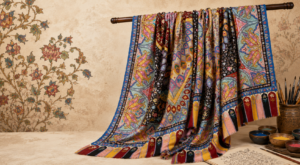
Somewhere between fine art and wearable textile sits a category that most buyers never encounter until one finds its way into their hands. A Kalamkari Pashmina shawl occupies that rare space – an object built from one of the world’s most extraordinary natural fibers, decorated through a painting tradition over three thousand years old, and then elevated further through hand embroidery that transforms a flat painted surface into something dimensional, layered, and genuinely unrepeatable.
Three separate craft disciplines. Three categories of trained artisans. Months of sequential production work. The finished piece carries all of that history without advertising it – and that understatement is precisely what distinguishes it from every mass-produced alternative claiming the same territory.
Kalamkari Shawl Meaning – The Ancient Craft Behind the Name
Persian gave the craft its name. Kalam translates as pen or reed. Kari means work accomplished by hand. Kalamkari, taken literally, describes the process with complete accuracy – skilled artisans drawing and painting directly onto fabric using hand-held instruments, with no mechanical assistance intervening between human intention and textile surface.
Its documented history on the Indian subcontinent spans over three thousand years. The tradition found its most refined expression in Andhra Pradesh, where two distinct schools developed along separate methodological lines.
Srikalahasti practitioners worked entirely freehand – each motif drawn directly onto fabric using a pen fashioned from bamboo or reed, tipped with tightly wound cloth or hair to hold and release pigment in a controlled flow. Machilipatnam developed alongside this tradition, incorporating hand-carved wooden block printing into the process while retaining hand-applied color at every stage.
Both schools share a foundational commitment to natural dye derived from botanical and mineral sources. Not as a stylistic choice, but as the defining technical characteristic that separates authentic Kalamkari fabric art from its countless imitations.
Natural pigment absorbed into fiber through mordant chemistry behaves differently from synthetic dye applied to a surface—the depth it produces, the way it ages, the quality of light interaction across the finished piece all reflect processes that industrial printing cannot reproduce.
When this painting tradition arrived on Kashmiri Pashmina, a textile category without precedent came into existence. Kalamkari Pashmina shawls bring one of the rarest natural fibers in the world into direct contact with one of India’s most ancient decorative arts – and then add a third layer through embroidery traditions that neither tradition was originally designed to accommodate.
The Pashmina Foundation – Why the Base Fiber Determines Everything Above It
Before any artisan touches a brush or needle, the Pashmina shawl base has already undergone months of skilled production work. Understanding that foundation changes how every subsequent stage reads.
Pashmina fiber originates from the Changthangi goat, native to the Changthang plateau of Ladakh at elevations exceeding 14,000 feet. Winters at that altitude subject these animals to temperatures severe enough to stimulate an inner fleece of biological necessity – exceptionally fine insulating fiber with individual strands measuring between 12 and 16 microns in diameter.
Human hair measures approximately 70 microns. That difference translates directly into the featherlight warmth and softness that defines Pashmina at its finest and that no synthetic or blended alternative reproduces with any convincing accuracy.
Spring molting allows hand-combing of this fleece from the animals. It travels from Ladakh to Kashmir, where cleaning precedes hand-spinning on traditional wooden charkha wheels in small workshops.
The spinning itself is skilled craft – drawing raw fiber into consistent yarn without mechanical tension requires years of practiced control, and the quality of the yarn determines the quality of every subsequent process. Handloom weaving follows. A single shawl base demands over ten full working days before any decoration begins.
Since 2008, a Geographical Indication tag has legally protected the designation Kashmiri Pashmina, defining both geographic origin and production standards that distinguish authentic fiber from imitation. Pashmina Vogue sources exclusively from workshops whose credentials meet this authenticated standard.
Documentation is available for every piece in the collection – not as a formality but as evidence of a traceable production chain.
The Kalamkari Painting Process – Four Sequential Stages Covering Six to Eight Weeks
The painting stage involves four distinct phases, each dependent on the previous one being completed correctly. Shortcutting any stage compromises the result irreversibly.
Mordanting and Fabric Preparation
The handwoven Pashmina receives a mordant treatment before any pigment is applied. Myrobalan fruit solution – the traditional choice in Kalamkari practice – soaks into the fiber and creates chemical anchor points for natural dye molecules.
Without this preparation, color cannot bind into Pashmina fiber properly regardless of application technique. The mordanting cycle takes several days including drying time between treatment stages, and its quality directly determines the depth and permanence of every color applied afterward.
Freehand Outlining by the Kalamkar
A Kalamkar—the master painting artisan—works the compositional outline directly onto the mordanted Pashmina using a tapered bamboo kalam dipped in black dye derived from iron sulfate solution or aged rust concentrate. No printed pattern is transferred first. The design originates from the artisan’s pattern memory, from compositional vocabulary accumulated through years of apprenticeship, or from original creative work developed independently.
Every mark made is permanent on fiber contact – there is no revision, no correction, no painting over errors. This permanence demands a quality of confident execution that accumulates only through sustained practice measured in years.
Sequential Natural Dye Application
Color is built across the composition one pigment at a time. Madder root produces reds and deep pinks. Turmeric and pomegranate rind yield yellows and warm golds. Indigo provides blue. Pomegranate leaves create green.
Between each individual color, the shawl is washed in clean water, dried in open air, and re-treated with mordant before the next pigment is introduced. A composition using six natural colors completes this full treatment cycle six separate times.
This sequential absorption process produces the layered color depth that distinguishes genuine Kalamkari from printed alternatives. Pigment absorbed into fiber through repeated individual treatment cycles builds differently from color applied simultaneously to a surface – the depth is structural rather than superficial, and it responds to light and age accordingly.
Final Wash and Color Reveal
A comprehensive final wash removes unbound pigment from the fiber surface and allows the fully absorbed color to express itself without interference. What emerges carries a warmth and complexity of tone that reflects weeks of sequential treatment – qualities that digital textile printing cannot replicate because its mechanism of surface application fundamentally differs from dye absorbed through successive mordant chemistry cycles.
The Embroidery Stage – How Kashmiri Needlework Applied Over the Painting Creates a Three-Dimensional Surface
Most accounts of Kalamkari Pashmina conclude with the painting stage. That omission is significant, because the embroidery applied afterwards represents an entirely separate layer of skilled production and is what genuinely distinguishes fine pieces from painted-only work.
After painting and final washing are complete, the shawl passes to embroidery specialists—artisans trained in using special pen called a kalam to fill the painted area with different colours, traditions that bear no relationship to Kalamkari painting.
Their work is done with reference to the painted composition beneath, following its outlines, filling interior areas, and adding thread that lifts the two-dimensional painted surface into dimensional form.
Zari Gold and Tilla Silver Thread
Certain Kalamkari Pashmina shawls incorporate metallic thread embroidery at focal points within the painted and stitched composition. Zari is gold thread.
Tilla is silver. Both consist of real metal drawn into fine wire and wound around a silk or cotton core – not synthetic metallic fiber, which produces flat brightness that fades quickly and carries none of the depth of genuine metal.
Introduced at border accents, medallion centers, or specific paisley outlines where visual emphasis serves the composition, authentic Tilla and Zari produce a luminosity that shifts with every movement of the fabric. The contrast between matte natural dye surface, textured silk embroidery, and reflective metal thread generates a visual layering that is genuinely striking under any lighting condition. Genuine metallic thread in diffused natural light carries warmth and subtlety; under direct light it catches and shifts. Synthetic alternatives produce neither effect convincingly.
The complete production timeline – weaving, mordanting, Kalamkari painting across multiple dye cycles, Sozni and Aari embroidery, Zari or Tilla accent work, and final finishing – runs between three and six months for a moderately decorated piece.
Dense Sozni field coverage combined with elaborate Kalamkari painting extends this to twelve or twenty-four months. Both figures represent the genuine minimum for authentic work at each respective level of complexity.
Traditional Motifs and Their Cultural Significance in Kashmiri Textile History
Kalamkari motifs carry a visual vocabulary built across centuries of artistic practice and cultural exchange. The lotus appears throughout as a symbol of spiritual purity drawn from Hindu iconographic tradition older than written record.
The paisley descended from the mango form – a symbol of fertility and abundance in South Asian decorative tradition – its evolution into the familiar curved teardrop shape driven by sustained contact between Persian court aesthetics and Indian craft practice under Mughal cultural patronage.
The chinar leaf occupies particular significance in Kashmiri decorative tradition. The chinar tree defines Kashmir’s valley landscape in the way few botanical species define a region, and its distinctively lobed leaf form appears across Kashmiri woodcarving, papier mâché, architectural ornament, and textile art.
On a Kalamkari Pashmina, the chinar leaf is typically painted in deep, rich natural pigment and then outlined and detailed in Sozni embroidery – one of the most instructive examples of how painting and needlework function as complementary rather than independent processes in this category.
Mughal garden compositions – formal arrangements of flowering plants and symmetrical botanical elements drawn from the Persian paradise garden aesthetic – appear as central field designs on more elaborate pieces.
Their spatial complexity demands the most experienced Kalamkars, since the arrangement must remain visually coherent across the full dimensions of the shawl.
Authentic motif repetition always carries slight variation. A skilled hand never produces two identical flowers. The petals differ in subtle ways. Curves have intention but not mechanical precision. That natural inconsistency is the mark of genuine handcraft – and it is precisely what printed alternatives cannot reproduce, regardless of how closely they approximate the visual character of the original.
Uniqueness as a Standard – Why Every Genuine Piece Is Unrepeatable
Pen pressure varies naturally across a working session. Dye concentration shifts between successive dips into the pigment solution. Humidity in the drying environment affects how colors settle after each treatment cycle. The embroidery artisan makes hundreds of independent decisions about stitch placement and thread tension across months of work on each piece.
Every variable accumulates into a finished object that is genuinely singular – not simply assigned a unique serial number, but actually different in character from every other piece that exists.
Pashmina Vogue documents each Kalamkari shawl individually for exactly this reason. Purchasing from the collection means acquiring a specific, unrepeatable object – not selecting a unit from a managed inventory of identical products.
Identifying Authentic Pieces and Avoiding Printed Substitutes
Reverse dye penetration is the most reliable first test. Natural dye absorbed through repeated mordant cycles penetrates the full depth of the fiber. Genuine Kalamkari Pashmina shows a softened version of the front design on the reverse. Printed alternatives show a blank or uniformly colored reverse.
Painted line character distinguishes hand drawing from machine printing clearly. Kalam lines vary naturally in width – heavier where the pen moved slowly, finer where it moved quickly. Printed lines are mechanically consistent throughout. That uniformity is absence of handwork, not evidence of quality.
Embroidery reverse quality separates Sozni-embroidered pieces from machine-stitched alternatives. Authentic Sozni presents identically on both faces. Machine work or poor hand embroidery shows its anchor knots and uneven thread tension clearly on the reverse.
Why Pashmina Vogue Represents the Reliable Source
Acquiring a genuine Kalamkari Pashmina requires working with a supplier who can account for the complete production chain – from fiber authentication through painting through embroidery to final finishing.
Pashmina Vogue directly supplies handwoven pashmina to verified workshops where Pashmina fiber is documented, natural dyes are used throughout the painting process, and kalam kaar’s sit and work on each piece of pashmina.
There are no shortcuts within that chain – and that integrity is what the quality of the collection consistently reflects.
Care That Preserves Both Painting and Embroidery Over Decades
Hand wash only in cold water using pH-neutral wool-safe detergent. For pieces with significant Sozni, Aari, or metallic thread embroidery, specialist dry cleaning is the safer choice.
Press water out gently without wringing and dry flat away from direct sunlight, which gradually lightens natural pigments.
Iron only face-down on a protective cloth at the lowest available steam setting – direct heat contact permanently flattens raised Sozni stitches and damages Zari thread. Store folded in breathable cotton, not sealed plastic. Cedar blocks provide moth protection without the chemical compounds that damage natural protein fiber.
Natural dyes on well-maintained Pashmina deepen in tone across years of careful use. Embroidery thread settles and softens with wear. Both qualities improve the piece over time – which is what genuine textile investment looks like in practice.
FAQs
1. What exactly is a Kalamkari Pashmina shawl?
It is a handwoven Pashmina shawl that is first hand-painted with natural dyes using a bamboo kalam pen, and then further worked with hand embroidery – fine silk or natural cotton thread or metallic Zari thread – applied over the painted surface. Three separate crafts, three different specialists, one finished piece.
2. Why does the embroidery matter if the painting is already there?
Because painting alone is two-dimensional. Embroidery applied over the painted motifs add raised texture and dimensional depth that paint cannot produce. The thread and the pigment work together – one defines color, the other defines form.
3. How long does the full production take?
Three to six months for a moderately decorated piece covering weaving, painting, and embroidery. Dense Sozni field coverage with complex Kalamkari painting takes twelve to twenty-four months. There is no faster version that is still genuine.
4. Why is it priced higher than other embroidered Pashmina shawls?
Three crafts are involved instead of one. The fiber itself is rare and expensive by weight. The painting alone takes six to eight weeks across multiple natural dye cycles. The embroidery adds months of specialist work afterward. Every element of the price reflects real labor by real people.
5. Where is the right place to buy one?
Pashmina Vogue sources directly from verified Kashmiri artisan workshops and provides full documentation – fiber origin, painting process, embroidery technique – for every individual piece. That chain of accountability is what makes the difference between a genuine piece and an expensive mistake.