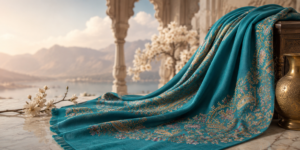
Hold a genuine Pashmina shawl for the first time and something unexpected happens. You look for weight. There almost is none. You brace for the scratch of fine wool. It never comes. What you feel instead is a warmth that seems disproportionate to the fabric in your hands – as if the material is generating heat rather than simply holding it.
That is not a coincidence. It is physics, biology, and centuries of craft working in exact alignment.
At Pashmina Vogue, we have spent more than a century working directly with Kashmiri artisan and verified Changthang-origin sources. We have handled thousands of shawls across every grade of fiber and quality of weave. And the question we are asked most consistently- by first-time buyers and seasoned collectors alike- is the same one: what actually makes Pashmina the most luxurious shawl in the world?
The answer is not simple. But it is specific. And it begins at 14,000 feet above sea level.
1. Before We Talk About the Fiber
Most articles on Pashmina lead with the fiber. Understandable. The fiber is extraordinary.
But that approach skips a more fundamental question: what does luxury actually mean when it is applied to a textile? Because if we cannot answer that, we have no real way to evaluate whether Pashmina earns the title or merely inherits it through historical association.
True luxury in fabric sits at the intersection of four things. First, raw material that is scarce by nature – not by design, not by artificial limitation, but because the earth simply does not produce much of it. Second, a production process that cannot be meaningfully replaced by machines without destroying the thing that makes the product worth having. Third, a history of cultural significance that stretches beyond trend cycles and fashion seasons. Fourth, a finished sensory experience that buyers return to again and again, not because they have been told to value it, but because the material itself keeps earning the response.
Most luxury textiles meet two of these criteria strongly. Some meet three.
Pashmina, in its authentic form, meets all four. That is not a claim we make lightly at Pashmina Vogue. It is the framework against which we evaluate every piece in our collection.
2. The Changthangi Goat and the Plateau That Creates It
The Changthang plateau of Ladakh sits at an elevation between 14,000 and 15,000 feet. In winter, temperatures drop to negative 40 degrees Celsius. Sometimes lower. The landscape is spare: wind-scoured, high-altitude cold desert, far above the treeline, interrupted by frozen lakes and the occasional nomadic encampment.
Nothing in that description suggests a cradle of luxury. And yet.
The Changthangi goat- a specific breed of Capra hircus native to this plateau – survives those winters by growing a double fleece. The outer coat is coarse, wind-resistant, and functional. Beneath it grows an inner undercoat so fine that its individual fibers measure between 12 and 16 microns in diameter. A human hair, by comparison, averages around 70 microns. Fine Merino wool sits at 18 to 22. The best commercial cashmere ranges from 15 to 19.
At 12 microns, fiber crosses a sensory threshold. It no longer registers as texture against skin. It registers only as warmth. That is why a genuine Pashmina shawl worn against bare skin feels like nothing- in the best possible sense of the phrase. There is no prickle, no resistance, no sensation of wearing something at all. Just heat.
Every attempt to reproduce this outside the Changthang plateau has failed. The breeding trials conducted at lower altitudes produced fiber, but not pashm of this quality. The biology is inseparable from the ecology. The extreme cold is not incidental to the fiber- it is the mechanism that creates it. Moderate the climate and you moderate the undercoat. Change the location and you change the animal.
This is why no synthetic fiber has genuinely replicated Pashmina’s sensory character. It is not a formula that can be reverse-engineered. It is a biological response to a specific and irreplaceable environment.
Each adult Changthangi goat yields between 80 and 170 grams of usable pashm per year. After removing the coarse outer guard hair during de-hairing, the usable yield per animal is closer to the lower end of that range. A single full-sized shawl requires fiber from three to four goats. One year of their production. That scarcity is baked into every thread.
3. The Changpa: A Community of 9,000 Keeping a Tradition Alive
The Changpa are the nomadic herders of the Changthang plateau. Fewer than 9,000 people, split across approximately 14 territorial groups, each with its own grazing area, its own chief, its own migration routes developed over generations.
Every spring, when temperatures on the plateau edge slightly upward and the Changthangi goats begin to shed their winter undercoat, the Changpa comb the fiber by hand. Gently. Systematically. A rough comb or a rushed pass damages the fiber at the source and that damage carries all the way through to the finished shawl.
The combed fleece- mixed with coarse hair, organic material, dust from the plateau- is sold to traders who carry it to Kashmir. There, the real transformation begins.
Kashmiri spinners, predominantly women working at home on a charkha, separate the fine pashm from the remaining impurities and draw it into yarn by hand. This is slow work. Skilled work. The resulting yarn is finer than most mechanical spinning systems can handle without breaking it. It is inherently a hand-process- not because hand-spinning is a charming tradition worth preserving, but because the fiber physically demands it.
From the spinner, the yarn moves to the weaver. From the weaver, depending on the design, to the embroiderer. Each of these is a distinct person, a distinct skill, a distinct stage of production. None of them can be rushed without the quality showing it.
At Pashmina Vogue, our sourcing process traces each shawl back through this chain. We work with workshops that can document both their fiber origin and their production methods. For a buyer, that documentation is not a luxury- it is the minimum standard that separates an informed purchase from a gamble.
4. From Raw Pashm to Finished Shawl: Eight Stages, No Shortcuts
Here is the production sequence of a genuine handwoven Kashmiri Pashmina shawl.
| Stage | What Actually Happens |
| Hand Combing | Changpa herders comb the undercoat from Changthangi goats each spring on the Changthang plateau |
| De-hairing | Fine pashm is separated from coarse guard hair by hand- trace contamination changes the finished feel of the shawl |
| Cleaning and Grading | Fiber is cleaned, sorted by fineness, and graded- the finest grades produce the lightest, most translucent shawls |
| Hand-Spinning | Spun on a charkha, the yarn retains a natural variation in diameter called loft- a quality ring-spinning eliminates |
| Warping | Spun yarn is arranged as the vertical foundation of the weave, a process requiring hours of careful setup |
| Handloom Weaving | Plain weave: days per shawl. Kani tapestry weave: 18 months to 3 years per shawl |
| Dyeing | Natural plant and mineral dyes applied at yarn or fabric stage; synthetic dyes used in lower-grade production |
| Embroidery | Sozni needle work, Tilla metallic thread, or Aari chain-stitch- each a specialized discipline requiring years of training |
A fully embroidered Pashmina shawl can represent more than 1,000 hours of skilled human labor by the time it is complete. That number is not a marketing figure. It is the honest arithmetic of what these stages require.
It is also why Pashmina Vogue prices reflect craft reality. When a shawl is priced to reflect what it cost to make, that price tells a story worth knowing.
5. Six Centuries of Royal Patronage
The earliest documented records of Kashmiri Pashmina shawls date to the fifteenth century. The craft existed before that in some form, but it was under Sultan Zain-ul-Abidin of Kashmir that the weaving traditions of the valley were systematically organized and elevated.
The Mughal Empire did the rest.
Emperor Akbar, who ruled from 1556 to 1605, formalized the khilat system: the practice of gifting robes of honor- typically made from the most precious textiles available- to nobles, allies, and dignitaries as a mark of imperial approval. A Pashmina shawl included in a khilat gift was not decoration. It was a declaration of rank.
The workshops of Srinagar operated under imperial patronage for generations. Techniques refined. Designs grew more complex. The boteh motif- what the West would later call paisley- was developed in these workshops over centuries of refinement, not borrowed from anywhere else.
By the eighteenth century, Kashmiri Pashmina had acquired an international reputation that no other textile in the world could claim. The Silk Road moved it westward. Persian nobles understood its value. Ottoman dignitaries acquired it. And when European traders and colonial officers encountered it firsthand, they brought it back to courts that had never seen anything like it.
6.How Pashmina Rewrote Global Fashion
Empress Josephine de Beauharnais of France collected them by the hundreds. Not dozens. Hundreds. Received as diplomatic gifts, acquired through traders, accumulated over years. Her enthusiasm for Kashmiri shawls popularized them among the French aristocracy with an influence that outlasted the Napoleonic era and shaped European textile taste through two subsequent imperial periods.
The shawl worked with French fashion because it had to. High-waisted Empire gowns were cold. A Kashmiri Pashmina shawl provided warmth without distorting the silhouette- and added visual richness that European looms of the period could not replicate. The combination of extreme softness and the prestige of Himalayan origin made it an object of aspiration across every level of French society that could aspire to it.
In England, Kashmiri shawls became something even more interesting: a financial instrument. English law of the nineteenth century severely restricted women’s ability to own property. Kashmiri shawls became portable stores of high-value wealth that women could hold, inherit, and transfer independently. They were not just fashionable. They were economically functional.
British mills in Paisley, Scotland, took the boteh motif, mass-produced it at industrial scale, and sold the copies cheaply enough to undercut Kashmir’s original market. The pattern traveled the world under a Scottish town’s name. The source was erased from the story.
That appropriation is itself a measure of Pashmina’s cultural force. A textile tradition powerful enough to inspire industrial theft on two continents and rename a global pattern is not a regional craft. It is a world-historical phenomenon.
The curated heritage collection at Pashmina Vogue brings that tradition to contemporary buyers: plain handwoven shawls for daily use, fully embroidered pieces for considered occasions, and Kani-woven works that represent the tradition at its most technically demanding.
7. What the American Buyer Needs to Know
There is no legal protection for the word “Pashmina” in the United States. The Federal Trade Commission treats it as a generic alternative name for cashmere- which means it can be printed on a tag attached to a viscose scarf, an acrylic wrap, or a low-grade wool blend, with zero legal consequence for the seller.
This is not a fringe problem. It is the dominant reality of the “Pashmina” market in America.
A few things help.
Ask for documentation. Not a vague “sourced from Kashmir” statement- actual fiber content specification and geographic origin. Reputable retailers including Pashmina Vogue provide this on every product listing. If a seller cannot or will not specify fiber content, that absence answers the question for you.
Run a burn test. Pull a thread from the shawl and hold a flame to it. Genuine Pashmina burns slowly, crumbles to ash, and smells faintly like singed hair. Synthetic fiber melts, beads, and produces a sharp chemical odor. This test separates natural from synthetic but will not distinguish Pashmina-grade cashmere from lower-grade cashmere on its own.
Think about pricing logically. A hand-spun, handwoven Kashmiri Pashmina shawl has real production costs. The fiber is scarce. The labor is skilled and slow. Products priced dramatically below what honest production would require are not what their labels say they are.
Look for a GI tag. Kashmiri Pashmina has held a Geographical Indication designation under Indian law since 2008. The Craft Development Institute in Srinagar issues CDI holograms to verified pieces. Not every authentic piece will carry one, but the presence of documentation is always a positive signal.
At Pashmina Vogue, complete sourcing and fiber disclosure is standard on all listed products- not a premium feature. Buyers deserve to know what they are purchasing.
8. Genuine Pashmina Is Getting Rarer- Here Is Why That Matters
Three things are reducing the supply of authentic hand-spun, handwoven Kashmiri Pashmina. None of them are likely to reverse.
The Changpa community is shrinking. Fewer than 9,000 people sustain the herding tradition that makes pashm available to the world. The next generation is increasingly choosing urban life over the extreme conditions of the Changthang plateau. The knowledge required to manage Changthangi goats at 15,000 feet is deeply contextual- it cannot be learned from books or taught in a classroom.
Climate patterns on the plateau are shifting. The defining cold of the Changthang winter- the biological mechanism that produces fine pashm- is under pressure. Any warming of the ecosystem affects the undercoat’s fineness. The fiber becomes what the cold makes it. Less cold means less pashm of the finest grade.
Kashmir’s artisan population is aging. Hand-spinning and handloom weaving are time-intensive disciplines with steep learning curves and no industrial shortcuts. Younger Kashmiris have options that were not available to their parents. The population actively practicing Kani weave technique- the most complex and most time-consuming of Kashmiri weave traditions- is small and has not grown in a generation.
The implication for a buyer is practical and clear. Authenticated Kashmiri Pashmina at the finest grades will become less available, not more. Its production is governed by geography, climate, and the choices of a small and increasingly pressured human community. A genuine piece acquired now is a piece secured before further contraction in supply.
Pashmina Vogue’s full collection of authenticated handcrafted shawls, stoles, and wraps is available at pashminavogue.com- each piece selected for fiber quality, artisan provenance, and honest craft integrity.
Frequently Asked Questions
What actually separates Pashmina from every other luxury shawl?
The combination of four things: fiber that exists only in one plateau ecosystem on earth, a production process that machinery cannot replace at quality level, six centuries of documented royal and cultural history, and a finished sensory experience that no other natural material has matched. Most luxury textiles achieve two or three of these. Pashmina achieves all four.
Why does a real Pashmina shawl cost what it does?
Each Changthangi goat produces only 80 to 170 grams of usable pashm per year. A single shawl uses fiber from three to four animals. Add hand de-hairing, charkha spinning, handloom weaving, and professional embroidery- the total skilled labor for a fine piece exceeds 1,000 hours. Every rupee of that cost is visible in the finished textile.
Can this fiber be produced anywhere outside Ladakh?
No. Breeding trials at lower altitudes have consistently produced coarser fiber because the extreme cold of the Changthang plateau- reaching negative 40 Celsius- is the biological trigger for fine pashm. This is not a cultural claim. It is an ecological fact recognized formally by India’s Geographical Indication designation since 2008.
How do I know if a shawl being sold as Pashmina is genuine?
Request explicit fiber content documentation and geographic origin from the seller. Burn a thread: genuine Pashmina burns slowly and smells like hair. Look for a GI tag or CDI hologram from the Craft Development Institute, Srinagar. Apply price logic- authentic production has real costs that rock-bottom pricing cannot honestly support.
Will Pashmina hold its value over time?
Structurally, yes. Supply is declining. The artisan population is aging. The Changpa community is shrinking. The conditions that produce both the fiber and the craft are under sustained pressure. A quality authenticated piece acquired now is a piece secured ahead of further supply contraction- which historically is precisely when value consolidates rather than diminishes.
How do I wear Pashmina in a way that reflects its quality?
Let the textile do the work. Plain weave shawls belong in travel, in transitional weather, over eveningwear where a jacket would be too much. Embroidered and Kani pieces carry their own visual statement- pair them with clean, quiet clothing that gives the shawl room to read. Minimalism is the correct frame for a Pashmina of genuine quality.