
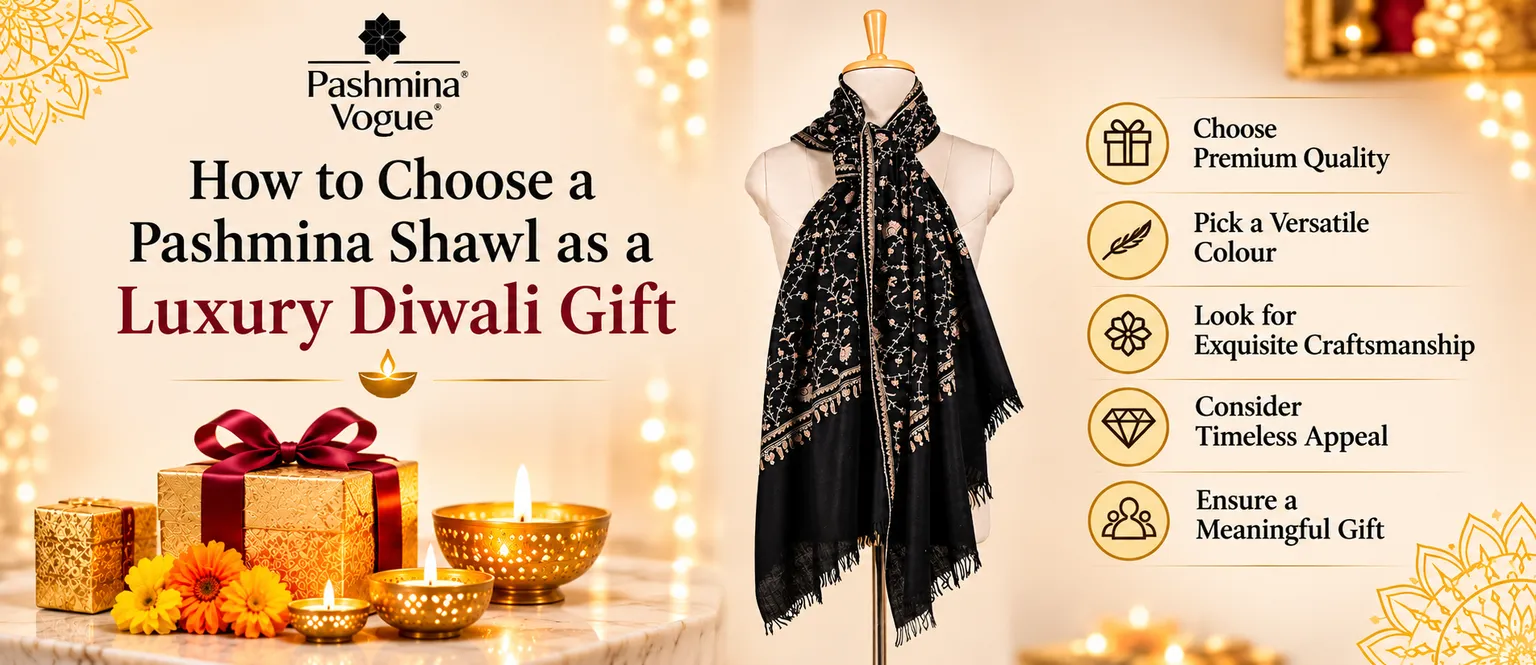
How to Choose a Pashmina Shawl as a Luxury Diwali Gift

A pashmina is one of the few gifts that suits almost everyone on a Diwali list, from a mother-in-law to a senior colleague. It is also one of the easiest to get wrong. The market is full of blends and imitations sold under the same name, and a poorly chosen shawl looks nice in the box but disappoints within a season. Choosing well comes down to a handful of checks on fibre, weave, craftsmanship and the person receiving it.
What makes a pashmina a luxury gift
Genuine pashmina comes from the soft undercoat of the Changthangi goat, which lives on the high plateau of Changthang in Ladakh. The animals grow this fine inner fleece to survive extreme cold, and it is combed by hand rather than shorn. The fibre is commonly described as finer than about 16 microns, which is why a real pashmina feels weightless yet warm.
Most of the value sits in the labour: combing, hand-spinning, weaving and, where it applies, embroidery. That is the reason a gift-worthy shawl costs far more than a machine-made scarf, and why the price alone is a useful early signal.
Check authenticity before anything else
Nothing else matters if the shawl is not what the label says. Many products sold as pashmina are blended with sheep wool, viscose or nylon, and some contain no cashmere-type fibre at all.
Start with the fibre content. A trustworthy seller will state it plainly, for example “100% pashmina” or the exact blend ratio, and will say whether the piece is handspun, handwoven or machine-made. Vague wording such as “pashmina-style” or “pashmina feel” usually means the product is not pashmina.
Next, look for certification. Kashmir Pashmina carries a Geographical Indication (GI) tag, and certified pieces come with labelling or a hologram that you can ask the seller to explain. Be aware that labels can be faked, so certification works best alongside clear answers from the seller rather than in place of them.
Finally, treat the feel as a clue rather than proof. Real pashmina is soft with a slight natural irregularity, and it warms up quickly against the skin. Synthetic imitations often feel slippery or oddly smooth. Burn tests and the old “pull it through a ring” trick are unreliable, and a burn test ruins the gift. Also avoid anything sold as shahtoosh, which comes from the endangered Tibetan antelope and is illegal to trade.
Whether you buy from Pashmina Vogue or any other specialist, ask these questions before paying, and take hesitation as your answer.
Understand weave, weight and size
Weave changes how a shawl looks and behaves. A plain weave is light and fluid, a twill weave has a subtle diagonal texture and a little more body, and diamond or herringbone patterns add visible structure. For a first luxury gift, plain or twill is the safest choice because both drape well and suit most outfits.
Weight matters as much as weave. Ultra-fine pieces are extraordinarily light and delicate, which makes them wonderful for occasional wear but less forgiving in daily use. A slightly heavier weave handles regular wear better and stays warm in North Indian winters, which is worth considering if the recipient will actually use it in December and January.
Size also changes the purpose. Stoles of around 70 × 200 cm suit layering over formal wear. Larger shawls of roughly 100 × 200 cm wrap fully and double as winter outerwear. Sizes vary between makers, so check the dimensions rather than assuming.
Embroidery: where the gift value really shows
Plain pashmina is elegant, but embroidery is what turns it into an heirloom. A few traditions are worth knowing:
- Sozni: very fine needlework in thread, often in floral or paisley motifs, which can take weeks or months on a single piece.
- Kani: a pattern woven into the fabric on small wooden bobbins instead of stitched on, and among the most labour-intensive Kashmiri textiles.
- Aari: hook embroidery, typically bolder and quicker than sozni.
- Papier-mâché: painted-style motifs derived from Kashmiri craft traditions.
A practical rule is that denser work means a higher price and a more formal feel, while a narrow border suits a gift for someone who prefers understated clothing. Because heavy embroidery can pull on lightweight fabric, the quality of the stitching matters more than the quantity. Turn the shawl over and check that the reverse side is neat, since the back of hand-embroidery is where weak work shows.
Choose colours and designs for the person, not the festival
Diwali tempts buyers towards red, gold and bright jewel tones, but the recipient’s wardrobe is a better guide. Someone who wears mostly neutrals will use an ivory, taupe or soft grey shawl far more often than a loud orange one. Deeper shades such as wine, emerald or navy are dependable for people who like colour, and our guide to Diwali pashmina colours covers how those shades behave with different outfits.
If you are unsure, plain or tonal designs are the safest option, because they work with whatever the person already owns.
Match the shawl to the recipient and the budget
Different relationships call for different choices:
- Parents and elders: a warm, slightly heavier weave in a dignified colour, with a modest border.
- A spouse or partner: a finer piece with detailed embroidery that she or he might not buy personally.
- Colleagues and clients: a refined plain or tonal shawl, which avoids anything too personal or ornate.
- Bulk or corporate gifting: consistent quality and a seller that can supply matching pieces and documentation.
Set a budget early and be sceptical of anything that sits far below it for a genuinely handwoven piece. A realistic spend buys real fibre and honest construction. An unrealistically low price usually means a blend.
Look at presentation and after-sales support
A luxury gift should arrive in suitable packaging, ideally with a care card and some documentation of the fibre and origin. Check the return or exchange policy too, since a shawl bought without the recipient present may need a different colour. If the piece is embroidered to order, ask about lead time, because custom work cannot be finished in a few days.
Care instructions are part of the gift. Pashmina should be folded rather than hung, stored in breathable cotton with cedar or a similar natural deterrent against moths, and dry-cleaned by someone who handles delicate wool.
A gift that lasts beyond the festival
The strongest pashmina gifts share the same qualities: honest fibre, careful weaving, restrained design and a colour the recipient will actually wear. If you want to see how a specialist presents these details, Pashmina Vogue and other reputable sellers should be ready to explain every point above. Spend your effort on those checks and the shawl will be worn and remembered for many winters after the diyas are packed away.
Read More:- Best Pashmina Shawl Colours for Diwali: Wine, Emerald, Ivory and Gold
Frequently asked questions
How much should I spend on a luxury pashmina gift?
There is no fixed figure, but genuine handwoven pashmina costs noticeably more than machine-made blends. Decide a budget first, then compare sellers on fibre disclosure and craftsmanship, not price alone.
Is pashmina the same as cashmere?
Both come from the undercoat of goats, but pashmina refers specifically to the fibre from Changthangi goats of the Himalayan region, traditionally processed in Kashmir. The terms are often used loosely in retail, which is why asking for specifics matters.
Which is better for gifting, a stole or a shawl?
A stole is easier to style and cheaper, while a full shawl gives more warmth and presence. For elders and winter use, the larger size is usually appreciated.
Can a pashmina be gifted without knowing the person’s colour preference?
Yes. Ivory, taupe, grey and navy rarely clash with anything, and a gift receipt or exchange option removes the risk.
